Hooks, Not Holes: Hanging Pictures in a Period Rental Without Touching the Plaster
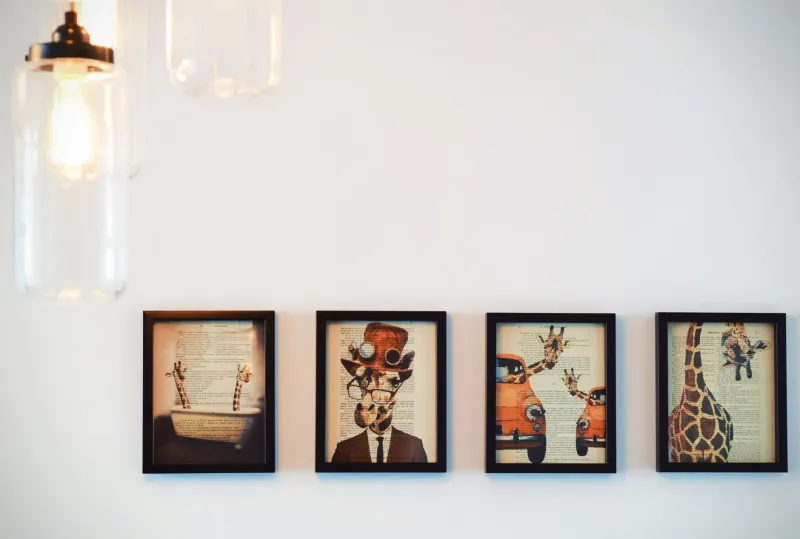
You've got the keys to a flat with a bay window, cornicing, and a tenancy agreement that says, in effect, no holes. So how do you hang eighteen frames' worth of prints without handing back your deposit in a box?
The short answer is that most of what makes a Victorian rental feel like yours can be done with hooks, cord and a bit of patience. The longer answer involves knowing what your walls are actually made of, because lath and plaster, plasterboard and brick all behave very differently when you ask them to hold something up.
Before you buy a single hook, read the wall
Knock on it with your knuckle. A hollow, dry rattle that sounds like there's a cavity behind the surface usually means plasterboard. A duller, denser sound with a slight give is period lath and plaster, which is what you'll find in most Victorian and Edwardian flats.
Then try a magnet. On plasterboard it will snap to the screw heads holding the boards to the studs, which is genuinely useful information later. On lath and plaster it tends to find nothing, because the fixings are buried deeper.
Two things to know about old plaster. It is soft, and the surface is often distempered, limewashed or painted with something chalky and matte, which a modern adhesive strip will happily peel away, taking the skim coat with it. And it cracks. If a wall already has a hairline network across it, treat it as decorative rather than structural and keep anything heavy off it.
Also do the boring bit: read the tenancy agreement, or ask the letting agent what's acceptable. Plenty of contracts ban nails and screws outright but say nothing about adhesive strips or picture hooks. Get the answer in an email. That email is worth more than any fixing.
The picture rail is the best thing about your flat
If you have a picture rail, a thin moulded strip running round the room roughly 30 to 45 centimetres below the ceiling, you have a hanging system that has worked for more than a century and damages precisely nothing. Brass picture hooks cost a few pounds each and hook over the rail; a length of cord drops down to the frame.
Two hooks spread wide on a large frame keeps it level and shares the load. Unlike adhesive, a sound picture rail will comfortably take a proper glazed print, or even a small mirror. Give it a firm tug before you trust it with anything you'd be sad to lose.
No rail? Look for a dado, a chimney breast that lets you lean larger frames on a sideboard, or simply hang lower and lean.
Adhesive strips work, within limits
The removable adhesive strips sold in every hardware shop and supermarket are genuinely good, as long as you respect what they can't do.
Clean the wall first with isopropyl alcohol and let it dry completely. Dust and kitchen grease are the usual reason strips fail. Press firmly for at least thirty seconds, then wait. Manufacturers say an hour; give it twenty-four, especially in a cold flat. Hang the frame, then leave it alone.
Halve the stated weight limit. A pack claiming 3kg is doing that in laboratory conditions on a perfect surface, and a glazed frame with a wide mount is heavier than it looks.
And keep them off fresh paint (leave it a fortnight), wallpaper, distemper, limewash, textured or damp surfaces, anything above a radiator, and anything in a bathroom or kitchen where steam does its quiet work. If you're unsure, stick a test strip behind the sofa, hang something light from it and check in a week.
While you're at it, upgrade the fittings on the back of your frames. Cheap D-rings and flimsy wire are the reason pictures sit crooked forever.
Shelves, and the honest answer about drilling
Anything carrying books, plants or a record player needs a mechanical fixing into something solid: a stud, a joist or brick. No adhesive on earth will hold a loaded shelf on old plaster.
So go freestanding. A ladder shelf, a slim bookcase, a leaning shelf against the chimney breast, a stack of crates. If your heart is set on wall-mounted shelving, ask the landlord for written permission, offer to make good before you leave, and accept that the answer might be no.
Laying it out so it looks deliberate
Cut paper templates the size of every frame, tape them up with low-tack tape and move them around for a few days before committing. Hang the centre of the arrangement at roughly 145 centimetres from the floor, which is gallery height and about where your eye lands. Leave five to eight centimetres between frames, and 15 to 20 above the back of a sofa. Anchor the whole thing with one large piece and build around it rather than starting with the small ones.
Don't march frames up to the cornice. A gallery wall that stops a hand's width below the ceiling looks intentional; one that touches it looks like a packing crate.
Leaving day
Photograph every wall when you move in and email the agent about pre-existing holes, cracks and marks in your first week. That record is what stands between you and a deduction eighteen months later.
Small picture-hook holes are usually treated as fair wear and tear, but not always, so check your contract. Filler, a light sand and a dab of matching paint deal with most of it. Ask the agent for the paint colours on day one, or peel a flake from behind a radiator.
Deposit disputes go to one of the government-backed schemes, TDS, DPS or mydeposits, and adjudicators tend to take a dim view of a landlord charging for a full repaint over four picture hooks. Still, it's far easier to avoid the argument altogether.
Renting doesn't have to mean bare walls. It just means knowing which walls to trust.